The Icon of the Breaking of the Bread

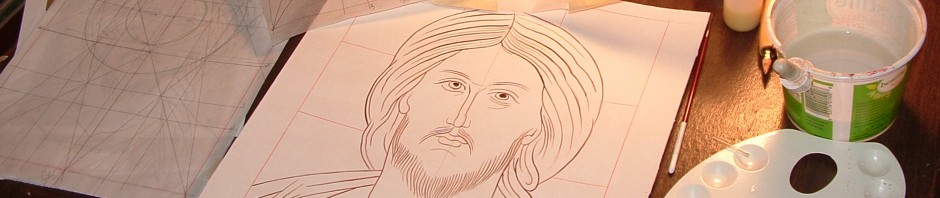
I haven’t done much blogging lately, but have instead been painting as much as possible.  A kind fellow blogger who is also an iconographer offered to teach me some new techniques.  His iconographic style is distinctly Romanian, and my earlier training was Russian, so it was hard sometimes to discipline myself to stick with his instructions and learn this new way.  I was so tempted to fall back into old habits, to do it my old way–but there would be no learning at all if I had done that.

So, I persevered, and my friend and most excellent teacher Cornel Apostol (you may know him from his wonderful photography blog called Words: “A picture is worth a thousand words”) led me patiently through all of the steps.  The icon is nearly complete.  I wanted to have it finished by the Feast of Corpus Christi.  It didn’t happen, and the icon is still not done, but I did want to share it with all of you now, as it has become such a vehicle of prayer and contemplation for me.

The image is of Jesus breaking a loaf of bread.  At first viewing of the original model, I was not really drawn to it.  The Lord’s gesture seemed too forceful, too exaggerated.  But then, as one needs to do with icons, especially ones that challenge, I began to really look at it. To gaze and to pray. It reminded me of something I had seen before.  I believe that it has been patterned after the figure of Christ in a very famous wall painting in the Monastery of Chora in Istanbul.

That image is of the Anastasis: the Orthodox icon for Easter, showing Jesus descending into hell–breaking down the gates in victory over death.  King David, Solomon, John the Baptist and numerous Old Testament prophets stand watching.

The Lord grasps Adam and Eve by the hands, and through them, all of us, bringing them from death into eternal life.  It is the image of salvation, the core of our faith.

And here, in this new icon, the similarly-posed figure of the Lord grasps not Adam and Eve but the bread of the Eucharist.  Our salvation is before us here and now in every celebration of the Mass, of the Divine Liturgy.

Posted in Catholic icons, Catholicism, Christian Prayer, Icon, Iconography, Uncategorized | Tagged , , , , , , , , | 11 Comments

Friends of the Martyrs

Reblogged from In Veritate Fortitudo:

Click to visit the original post

To the complete dismay and embarrassment of my children, I love roadside markers and historical plaques. They usually hide their faces in shame as I pull the car off the road and read the inscriptions. Curiosity about the history of an area motivates me, but often more fascinating is what one can learn about the views and prejudices of those who erected the sign.

Read more… 1,023 more words

I had never heard of this event before. I think it is something everybody should learn about.
Posted in Uncategorized | Leave a comment

Old Hymns and New Scenery

We went on an 900 mile roadtrip last week.  We saw so many interesting sights, but the best things of all were the constantly changing, gorgeous landscapes.  So much variety. It seemed that the terrain, flora, and fauna all changed every 25 or 30 miles, each uniquely beautiful in a different way.  One thing each area had in common is the old hymn they invoked me . . . one of my favorites of all times.

Oh Lord my God, when I in awesome wonder

consider all the works thy hands have made . . .

Central Oregon

Central Oregon

John Day Painted Hills

John Day Painted Hills

Lewis & Clark State Park

Lewis & Clark State Park

John Day Sheep Rock area

John Day Sheep Rock area

Wheat Farm,  Eastern Washington

Wheat Farm, Eastern Washington

Lyons Ferry State Park

Lyons Ferry State Park

Palouse Falls

Palouse Falls

Northeastern Cascade Mountains

Northeastern Cascade Mountains

Crooked River Gorge

Crooked River Gorge

Cascade Mountains

Cascade Mountains

Then sings my soul, my Savior God, to thee:  How great Thou art!  

How great Thou art!

Posted in Uncategorized | Tagged , , , , , , , , , | 3 Comments

The Icon of Pentecost

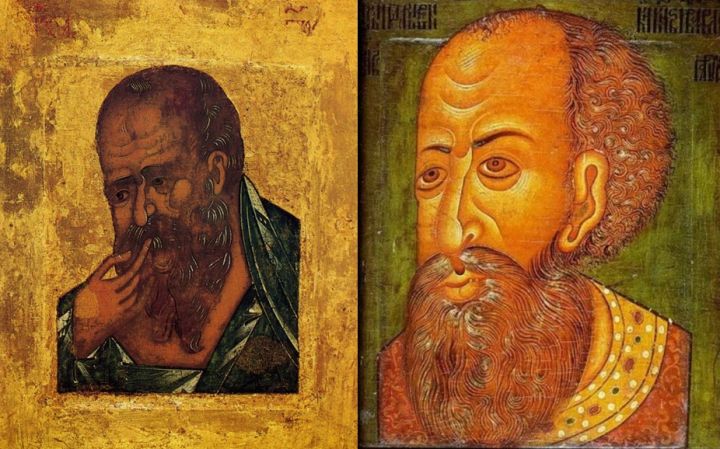
This is the festal icon of Holy Pentecost.  This particular version is Russian, likely painted in the 16th Century for the Cathedral of St. Sophia in the city of Novgorod. It might not be what you expected to see for an image of this feastday.

Here is shown the birthday of the Church, but not those dramatic moments of rushing wind,  tongues of fire, and the proclaimingof the Word in every language to amazed crowds, that are part of the Scriptural story of this wonderful day.

Instead, twelve figures are shown.  They sit together, serene, quiet and peaceful.  The composition, the gestures, and even the colors give a sense of unity and harmony. The Holy Spirit is depicted as a dark circular shape that represents the mystery of God.  Twelve rays of light emanate down from the circle, looking almost like water from a fountain, pointing down towards the twelve.  The men are quiet, still.  Their mouths are closed. They are listening rather than speaking, listening to the promptings of the Spirit.

The group, which includes the four evangelists as well as St. Paul,  surrounds an archway filled with darkness.  A tomb perhaps?  A king emerges.  His name is Cosmos, and he represents the entire world, in the way that a king represents and stands for his people.  He holds a cloth in his hands, with 12 objects on it.  He has come out of the darkness into the light to accept a gift of 12 scrolls of the Gospels, the Good News, on behalf of all nations.   As the symbolic representative of all of us, he accepts the Word of the Lord and comes from death into life.

There are variations on this icon.  After the 17th Century, many Pentecost icons show our Blessed Mother seated at the top center.  She is placed there because she is the symbol of the Church.

In many other icons, especially the earlier ones, that center place is empty.  The symbolism is that the space is not simply vacant but the place reserved for Jesus, as the invisible head of the Church. It is held there for Him in the image, waiting for His Second Coming.

What I like in this particular icon is that it isn’t just a waiting space.  The two apostles–St. Peter on the left and St. Paul on the right–face each other.  The symmetry of the space between them is in the shape of a chalice.  Above, the circle that stands for the Mystery of God, also resembles the Host.  The sacrament of the bread and wine, the Eucharist, is visually proclaimed as the center of our faith, as God’s Presence in the Church.
Posted in art, Catholic icons, Catholicism, Icon, Iconography | Tagged , , , , , , , , , , | 10 Comments

Four Lessons for Me

It’s been an interesting couple of weeks.  I have learned–and been reminded–of a lot of important things.  Most of them I learned not by doing something, but by quietly and attentively observing.  I want to share a few of them with you:

Last week, I had an opportunity to watch the painting of a monumental icon inside of a Catholic Church.  I had hoped to be able to assist in some small way, but to make a long story short —

Icon of Pentecost written through the hand of Mary Kasilometes

Icon of Pentecost
written through the hand of Mary Kasilometes

I was unable to do more than watch. That observation turned out to be just what I needed to be doing.  I felt overwhelmed, looking at the scale of this work.  It’s absolutely enormous. Life size figures.  Scaffolding.  A projection of years before it would be complete, along with 2 more huge images.  And as I watched, the iconographer worked carefully on the foot of one of the apostles in the icon.  She painstakingly  brushed on the details on that foot, redrawing and repainting, until each toe was just exactly right.

It was amazing to me that she could focus so closely on such a small thing, making every inch of this icon exactly right, when the big picture was so intimidatingly . . . big.  What a lesson in patience, diligence, and attentiveness, treating each little detail as important, not forgetting for a moment how every individual part is vital to the whole effort.

*

Yesterday I was working at the store as a cashier, and my next customer stepped up to pay for his purchases.  He was all smiles, so cheerful and pleasant that he lifted my tired spirits.  I asked him how his day was going, and he replied that it was wonderful, every day was wonderful. He shared with me that he had almost died a couple of years back, and he had learned from that awful experience that every day, every moment was a gift.  No worries were that important, nothing else really mattered, he was just so grateful and filled with joy at being alive.  He filled the store with light and happiness, and left everybody there smiling along with him.

*

Today I worked at the library, and saw a frequent patron come in today.  She might be homeless, certainly is very poor.  She says she is a poet, rather vague in her conversation and wanderings, perhaps a bit slow, or perhaps with some mental illness or both.  Or neither.  Haphazardly dressed, not too clean, but quiet, acquiescent, and polite.  Today she brought a child with her, a clean, well cared for, neatly dressed little boy.  She evidently was taking care of him and bringing him on a visit to the library.  Who would entrust their child to her, I wondered, judging her on sight as an unsuitable babysitter.  As they approached the self-service checkout, I could hear her and the child interacting.  She spoke lovingly, kindly, attentively to the little boy.  She taught him with patience and clarity how to check out his books.  He listened to everything she said, and obeyed.  There was obvious trust and affection between them. He had her full attention at every moment, and she had his. How wrong I was about her, how judgemental.  I have rarely seen a “nanny” as devoted and kind as this one.  Whether he was a relative or a neighbor of hers, how fortunate the child’s family was to find such a good caretaker for him.

*

One last story:  one of my dogs is epileptic, and he had a very bad day last Monday. His seizures make him cry out in pain.  He runs to us for help. There is nothing we can do for him, besides be there with him to comfort him until it is over.

I feel so powerless when these events occur.  I petted and hugged him,  so unable to help, yet so wanting to make it better.  This is not something that I can ever fix, it is totally out of my control.  I need to accept that sometimes all you can do for somebody is to just be present, that love can be comfort enough.

Ivan feels better now, and has put his distress behind him, and I need to do that also.  Let them all go, those things that we cannot change.  Do what we can do as well as we are able without seeking perfection.  Stop judging others.  Fill our hearts with joy, gratitude and love–and share it with one and all.

Posted in art, Catholic icons, Catholicism, Icon, Iconography, Uncategorized | Tagged , , , , , , , , | 6 Comments

John 14:27

This reflection is taken directly from the Little Books of the Diocese of Saginaw, Inc.  It is based on the writings of the late Bishop Ken Untener.  It is dedicated to SR: Being Faithful to Grace.

“Peace I leave with you; my peace I give to you.  Not as the world gives do I give it to you.  Do not let your hearts be troubled or afraid.”  (John 14:27)

The word “peace” appears 86 times in the New Testament.  Sometimes it refers to the absence of conflict.  Most often, it is used as a greeting.

When the risen Jesus met his disciples, his first words were, “Peace be with you.”  It’s the Hebrew word, Shalom.  It’s the word St. Paul used to begin a letter and to end his letters.

In today’s passage, it’s more than an idle wish for his disciples.  It’s a prayer for something to happen deep down inside of them.

When a storm blows up on a river, the waves are high, the water is rough on the surface, but if you dive down deep, it is still and peaceful.  Despite the wind blowing upstream, down deep the current still flows as it usually flows . . . peacefully.

While I’d love to have peace on the surface of my life, nobody can give me that. There are winds that blow and storms that come up.  That’s the way life is.

But I can have a deep-down peace inside my heart where I am most “me” and where I connect with God.  That’s the peace Jesus wishes for his disciples and the peace he gives them through the Spirit.

That’s the peace Jesus offers me.  What a gift.

Posted in Catholicism, Christian Prayer, Uncategorized | Tagged , , , | 5 Comments

Icons and Light

Christ Emmanuel attributed to Dionysius 16th century Russia

Christ Emmanuel
attributed to Dionysius
16th century Russia

An icon is not meant to be a likeness, not meant to be a physical portrait.  It is, rather, a spiritual portrait. It shows a glorified soul, transfigured by grace,  filled with the light and radiance of God’s love.  This light is interior, glowing from within, where the Spirit dwells.

There is no external light source: no sunshine, no candle, no flame nor lightbulb–not even a heavenly beam directed onto the figure in the icon.  No shadow is cast by any object or person in the icon.

One who has lived a holy life has a soul filled with light and overflowing with grace, and it is this radiance that illuminates an icon.

The Lamentation Monk Gregory Krug 20th Century

The Lamentation
Monk Gregory Krug
20th Century

In many classical styles of iconography, particularly the Russian techniques which I have studied,  shadows of any kind are rarely painted in at all.

To achieve this, the process of painting an icon more or less develops in this way.

One begins with flat, dark shapes or areas of color.  A few lines are put in to clarify detail, serve as a guide to placement of the highlights, and to provide a bit of contrast.

Then layers of light are built up, little by little, with yellow ochre pigments at first, gradually adding white.

The  figure is modeled and defined entirely through the painting of the light.

Posted in art, Catholic icons, Icon, Iconography, Uncategorized | Tagged , , , , , , | 5 Comments

Blessings and good wishes

Wishing a Joyous and Blessed Pascha to all of my Orthodox friends!

Christ is Risen!

 Indeed, He is risen!

Alleluia!

Hristos a înviat! Adevărat a înviat!

Let the heavens be glad;  let the earth rejoice.  Let the whole world, visible and invisible, keep the feast.  For Christ is risen, our eternal joy.

Posted in art, Christian Prayer, Icon, Iconography, Uncategorized | Tagged , , , , , , , | 3 Comments

Inverse Perspective

Most of us know about perspective from art classes in school–the common example being one of train tracks leading into the distance, coming to a single point.  The eye and brain have learned to see these cues and interpret the lines as depth, as a dimension and indication of space.
perspective drawing

The lines and angles serve to enhance this perception, giving a great sense of “realness” and naturalism to a painting or drawing.

perspective drawing1

Iconographers knew of this idea as well, but deliberately created a visual system which is quite the opposite. We call it “inverse perspective”.

Icons have been called a “window into heaven”.  The pictorial part of the wooden panel in the center is the heaven part.  The border/frame around it represents the world.  Many icons show halos (God’s radiance) or hands/ garments/etc overlapping into the border, as a symbol of the fact that God has entered the world through Jesus, and His presence and grace is active here among us.

Ouspensky St Nicholas of Myra

But there is more to this concept in the icon than these more obvious, painted symbols.  Inverse perspective carries this much further.

The background of the icon is flat.  There is no depth of space, and no attempt to suggest it.  The figures are more or less equal in size and brilliance of color, and depicted on the same plane.

Andrei Rublev Trinity

Buildings are oddly angled, and not the orderly vanishing-point progression we are used to seeing.  Like tables, platforms, and chairs, they seem to be tipped forward,  as if objects and figures might even slide forward out of the picture plane.

PresentationNov

If we were to diagram the icon with lines and vanishing points as in traditional perspective, we would make quite a discovery.  Instead of vanishing back into the “distance” of the painting like those proverbial train tracks, the icon moves forward. The lines all converge towards the viewer, converging on the person in prayer before the image–heaven moving towards the worshipper to meet him or her.  In the icon, the Divine is made present to us, coming towards us, bringing the kingdom of God close.  The point of convergence is you.

Posted in art, Catholic icons, Icon, Iconography, Uncategorized | Tagged , , , , , , | 8 Comments

The Hand of the Artist

One of the interesting things about taking an icon workshop is watching 10 to 20 people all take the same image, trace it onto their boards, paint it–and have 10 to 20 completely different-looking icons at the end.  No two alike.

Within the work of each artist, there are elements of unique style: direction of brushstrokes, colors chosen, techniques of application. . .  How do experts know that a given painting is a “genuine” Rembrant, or Van Gogh, or even a “reinkat”?  Always there are the unique indications of the hand of a certain artist.  Countless details reveal the creator.

So, too, we find the hand of God revealed in all of His creation.

circulatory system

I never cease to marvel, in my excursions in the yard and in town, on hikes, in traveling, at the wonderful hand of God visible in all of His creation. The symmetry, the perfection, the beauty, along with the fantastic flexibility, adaptation, and occasional untidiness–I am heartened and inspired to prayer by it all.

Posted in Uncategorized | 7 Comments